Eye research / Dry eye / 2023
Dry Eye Research in 2023: 32 Notable Human Studies
Three phase 3 perfluorohexyloctane trials anchored a year that also examined symptom burden and emerging dry-eye tests.
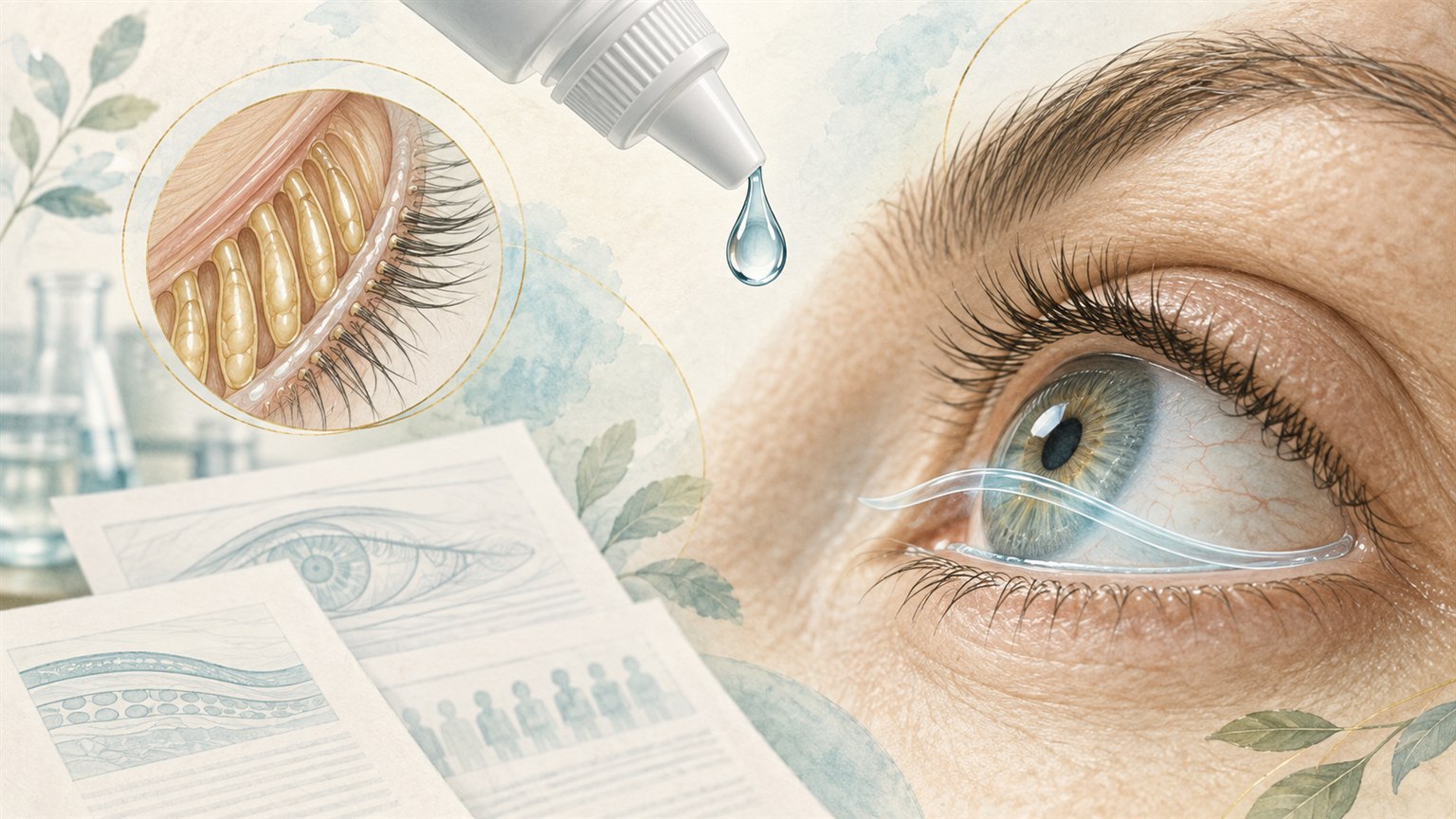
The 2023 picture
Three themes stand out:
- Three separate phase 3 trials found that perfluorohexyloctane improved both corneal staining and dryness symptoms in patients with meibomian gland dysfunction.
- A large cyclosporine trial improved corneal staining but did not beat its vehicle on the symptom co-primary endpoint.
- Surveys and biomarker studies underscored how strongly dry-eye estimates and test results depend on the population and measurement method.
What the research shows
The strongest 2023 treatment evidence came from randomized trials, especially three independent perfluorohexyloctane cohorts that found improvements in both staining and dryness. Other treatments produced more mixed results: cyclosporine helped a sign but not the symptom co-primary endpoint in ESSENCE-2, and several smaller comparisons showed limited symptom or tear-production gains. Population studies documented a real burden while using definitions and samples that cannot be combined into one prevalence figure. Promising image models and molecular markers still require outside validation.
Controlled treatments
Several trials tested therapies for gland-related evaporative dry eye, while others examined inflammation, tear film stability, and procedures. Similar drugs in different trials represent separate patient groups, not repeated reports of one experiment.
-
Perfluorohexyloctane in the GOBI phase 3 trial
The masked GOBI trial randomized 599 adults with gland-related dry eye to perfluorohexyloctane drops or hypotonic saline for eight weeks. Both corneal staining and reported dryness improved more with the active drops, meeting the trial's primary endpoints; adverse events were generally mild. The saline comparison and selected trial population limit what this study alone says about longer-term use or other causes of dry eye.
-
A second perfluorohexyloctane cohort in MOJAVE
MOJAVE was a distinct masked phase 3 trial that randomized 620 patients with meibomian gland dysfunction to perfluorohexyloctane or hypotonic saline. At eight weeks, both total corneal staining and dryness symptoms favored treatment, reinforcing the GOBI result in a separate cohort. The trial was short and compared the drops with saline rather than an established active treatment.
-
Perfluorohexyloctane tested in China
A separate randomized, masked Chinese phase 3 trial compared perfluorohexyloctane, called SHR8058 in the study, with hypotonic saline in 312 analyzed patients. After 57 days, corneal staining and dryness scores both improved more with the active drops. This supports the broader treatment program across settings, although follow-up remained under two months.
-
Water-free cyclosporine improved staining, but not dryness versus vehicle
ESSENCE-2 randomized 834 adults to 0.1% water-free cyclosporine or vehicle for 29 days. Corneal staining improved modestly more with cyclosporine, but the co-primary dryness score did not differ significantly between groups. The short study supports an effect on this surface sign, not a demonstrated symptom advantage over vehicle during the trial.
-
Platelet-rich plasma versus autologous serum in Sjögren dry eye
In a double-blind randomized study, 38 people with primary Sjögren-associated dry eye received platelet-rich plasma or autologous serum drops. Both groups improved in corneal staining and tear breakup time at four and 12 weeks, without a clear difference between treatments. Schirmer measurements and symptom scores did not significantly change, and the lack of an inactive control limits claims about either treatment's absolute benefit.
-
Two strengths of rebamipide in a placebo-controlled trial
A randomized trial assigned 220 patients to 1% rebamipide, 2% rebamipide, or placebo for 12 weeks. Tear breakup improved more with active treatment, and the 2% strength also showed a greater corneal staining benefit. Symptoms improved across all groups without a significant between-group OSDI difference, so the trial's sign results should not be translated into a proven symptom advantage.
-
Thermal pulsation before cataract surgery
Forty-six cataract patients with mild to moderate meibomian gland dysfunction were randomized to one LipiFlow treatment or a month of warm compresses and lid massage before surgery. Tear breakup, symptom, and gland measures favored LipiFlow before and after surgery. Each arm contained only 23 patients, treatment was not masked, and follow-up ended one month after surgery.
-
Combined light therapy versus sham treatment
A masked sham-controlled trial assigned 100 people with evaporative dry eye from gland dysfunction to three sessions of intense pulsed light plus low-level light therapy or sham treatment. OSDI symptoms and tear breakup time improved more with active treatment through three months; Schirmer results and gland expression did not significantly change. Because two light therapies were combined, this trial cannot isolate the contribution of either one.
-
Selenium sulfide ointment in a dose-finding gland trial
A 29-site, double-masked phase 2 trial randomized 245 patients with meibomian gland dysfunction to twice-weekly selenium sulfide ointment at one of two strengths or vehicle. At three months, the 0.5% group had more open glands and a larger symptom-score improvement than vehicle. Dose-finding results need confirmation and longer safety follow-up before defining the treatment's clinical role.
-
TearCare versus cyclosporine in the SAHARA trial
SAHARA randomized 345 patients at 19 U.S. sites to two TearCare procedures over six months or twice-daily cyclosporine 0.05%. Tear breakup improved more with the procedure, while OSDI symptoms improved in both groups without a significant difference between them. Assessors were masked, but patients could not be, and the trial compares the tested regimens rather than every way either treatment might be used.
Population patterns and daily experience
These studies describe symptoms, clinical diagnoses, environmental exposures, and functional burden. Their percentages use different definitions and selected populations, so they should not be treated as interchangeable prevalence estimates.
-
Dry-eye symptoms in Polish university students
A cross-sectional survey of 312 Polish university students found that 57.1% crossed the study's OSDI symptom threshold. Longer electronic-device use and several health or stress measures were associated with worse scores. The convenience sample and questionnaire cannot establish examination-confirmed disease or show that device exposure caused the symptoms.
-
How case definitions changed estimates in an English city
Researchers examined 282 adult volunteers in Birmingham, England, using both symptoms and ocular signs. About 32% met a TFOS DEWS II-based definition, while a symptom-and-history definition identified a somewhat different group. This volunteer sample helps illustrate the effect of diagnostic criteria; it does not establish a national prevalence for the United Kingdom.
-
Testing the 20-20-20 screen-break rule
Twenty-nine symptomatic computer users followed software reminders for 20-20-20 breaks during a two-week before-and-after study. Symptoms and digital eye strain eased while reminders were active, then the benefit faded after they stopped; most objective tear findings did not change. Without a randomized control group, the study cannot separate the breaks from expectation or other changes in screen behavior.
-
One hour of smartphone gaming in children
Thirty-six children ages six to 15 played a smartphone game for one hour while researchers measured blinks, symptoms, and tear signs. Blink frequency dropped substantially and symptoms increased immediately after play, but tear-film measures did not show a comparable change. This acute experiment cannot establish that regular gaming causes chronic dry-eye disease.
-
The reported burden of dry eye across eight European countries
A cross-sectional web survey compared 6,084 adults reporting dry-eye disease with 6,161 who did not. The dry-eye group reported worse daily visual function, general health, and work productivity, with greater burden at higher reported severity. Diagnosis and outcomes were self-reported, and self-selection limits causal or population-wide conclusions.
-
Air pollution and dry-eye clinic visits in Changchun
Investigators linked 10,809 dry-eye outpatient visits in Changchun, China, from 2015 through 2021 with city-level pollution and weather records. Particulate matter, carbon monoxide, ozone, and weather variables showed associations with visits in their models. Regional exposure estimates, care-seeking patterns, and possible confounding mean the study cannot prove that a given pollutant caused an individual patient's dry eye.
-
Humidity and symptoms across Spanish eye-care sites
A multicenter cross-sectional study assessed OSDI symptoms in 1,033 Spanish eye-care patients and compared places with lower and higher relative humidity. Symptoms above its threshold were somewhat more common in lower-humidity locations, but the adjusted humidity association did not reach statistical significance. Site differences and the lack of individual exposure tracking also limit a causal climate interpretation.
-
Dry eye before cataract surgery in a Norwegian clinic
Among 218 patients assessed before cataract surgery in Norway, 55.5% met a combined symptom-and-sign dry-eye definition. Symptoms were common but aligned poorly with measured signs, showing why either alone can miss part of the picture. These are patients seeking cataract care, not a representative sample of all older adults.
-
Weather before visits and changes in dry-eye measures
Researchers retrospectively related local temperature and humidity in the week before clinic visits to repeated measurements from 33 dry-eye patients. Lower temperature remained associated with worse symptoms, staining, and osmolarity in a multifactor analysis, while humidity did not remain an independent signal. This small clinic series is susceptible to other seasonal and personal factors and cannot establish weather as the cause.
-
Diabetes and dry-eye findings in an outpatient comparison
A cross-sectional ophthalmology-clinic comparison examined 400 people with and without diabetes. Moderate dry eye was reported much more often in the diabetes group, which also showed reduced corneal nerve sensitivity. Clinic selection and differences between patient groups prevent the observational result from quantifying diabetes' independent causal effect.
Measurement and diagnostic tools
Imaging and tear tests can identify differences between study groups, but the clinically useful question is whether they work reliably in new patients and add information beyond established assessments.
-
AI measured tear breakup in slit-lamp videos
Researchers trained an image model on more than 22,000 annotated video frames from 158 eyes of 79 patients. It estimated tear breakup time and distinguished dry-eye cases with an area under the curve of 0.877 against the study's diagnostic reference. The retrospective internal evaluation, including two eyes from some patients, needs replication in independent clinics before clinical use.
-
Tear osmolarity was a weak tracker of disease in DREAM
In 405 DREAM trial participants measured over a year, tear osmolarity explained less than 5% of variation in dry-eye signs and was not meaningfully related to OSDI symptoms. Changes in osmolarity also did not track changes in signs or symptoms. The analysis challenges its usefulness as a stand-alone severity or response measure within this treated trial cohort.
-
Another video model for identifying dry eye
A retrospective study trained a convolutional network on 244 ocular-surface videos, one eye per person, to distinguish dry-eye patients from healthy controls. Its internal test produced a high area under the curve of about 0.98. Case-control separation in selected videos is a promising technical result, but performance in routine patients and other clinics remains untested.
-
Tear MMP-9 and osmolarity did not perform alike
An observational study compared a tear MMP-9 immunoassay and osmolarity thresholds with clinical dry-eye severity. MMP-9 positivity showed clearer associations with staining and severity, while an osmolarity cutoff above 308 mOsm did not distinguish overall symptoms and signs. Neither association alone validates a test as a definitive diagnosis, and the abstract does not provide a sample size.
-
Clustering more than 82,000 meibography images
An unsupervised model grouped 82,236 meibography images from 20,559 people into six patterns of gland appearance. A subset of 280 participants had fuller ocular-surface assessments, and the image groups differed in gland loss and tear measures. These clusters were developed within this dataset and need outside validation before they can guide care.
-
Corneal nerve patterns and tear proteins
Confocal imaging and tear-protein measurements compared 43 dry-eye patients with 16 healthy participants. Corneal nerve branching was higher in the dry-eye group, and several tear proteins correlated with nerve measures. The small cross-sectional sample suggests possible links between nerve changes and the tear environment, not a validated biomarker or causal mechanism.
Tear and ocular-surface biology
Microbiome, cytokine, mucin, and RNA studies can generate hypotheses about disease mechanisms. Small samples and many simultaneous comparisons make independent replication particularly important.
-
Repeated swabs showed microbial differences in gland disease
Researchers repeatedly sampled the eyelid and conjunctiva over three months in 60 people with gland dysfunction, gland dysfunction plus lacrimal problems, or healthy eyes. Microbial communities differed across groups, but variation between individuals was also prominent. Swab sequencing cannot tell whether microbes contributed to the disease or changed in response to it.
-
Microbial genes and tear proteins in a small comparison
A 40-person study combined eyelid and conjunctival metagenomic sequencing with tear-protein analysis. Dry-eye and control groups differed in some microbial functions and tear proteins, including links involving mucin 16. These exploratory correlations do not establish a microbial cause of dry eye or a test ready for clinical use.
-
Tear extracellular-vesicle RNA in ten participants
Investigators sequenced RNA from tear extracellular vesicles in five people with very short tear breakup time and five with normal breakup time. Several transcripts differed between the groups in a screen of thousands of genes. The tiny discovery sample and extensive testing make independent replication essential before drawing diagnostic or mechanistic conclusions.
-
DREAM tear cytokines did not yield a clear severity panel
A DREAM analysis measured seven tear cytokines in 131 dry-eye participants from ten sites. None tracked symptoms clearly, and associations with signs were weak or sometimes opposite to a simple inflammation-severity pattern. The results caution against treating this small cytokine panel as an established measure of how sick a patient's eyes are.
-
Conjunctival mucin genes in screen users
Among 79 visual-display-terminal users, impression-cytology samples from 53 with dry eye and 26 controls showed lower expression of several conjunctival mucin genes in the dry-eye group. Some expression measures related to tear breakup or tear meniscus findings. The cross-sectional comparison cannot show whether mucin changes caused dry eye or followed it.
-
Tear proteomics during three active drop treatments
Eighty dry-eye patients in a masked trial received one of two cyclosporine strengths or diquafosol for 12 weeks while investigators tracked clinical measures and tear proteins. Several measures improved from baseline, but the changing proteins did not consistently follow clinical outcomes, and no clinically acceptable biomarker emerged. With only active arms, this analysis also cannot assign all within-group improvements to the drops.