Eye research / Dry eye / 2019
Dry Eye Research in 2019: 31 Notable Human Studies
Health-system and community studies tracked dry eye across populations as treatment trials and measurement studies examined the tear film, glands, and symptoms in practice.
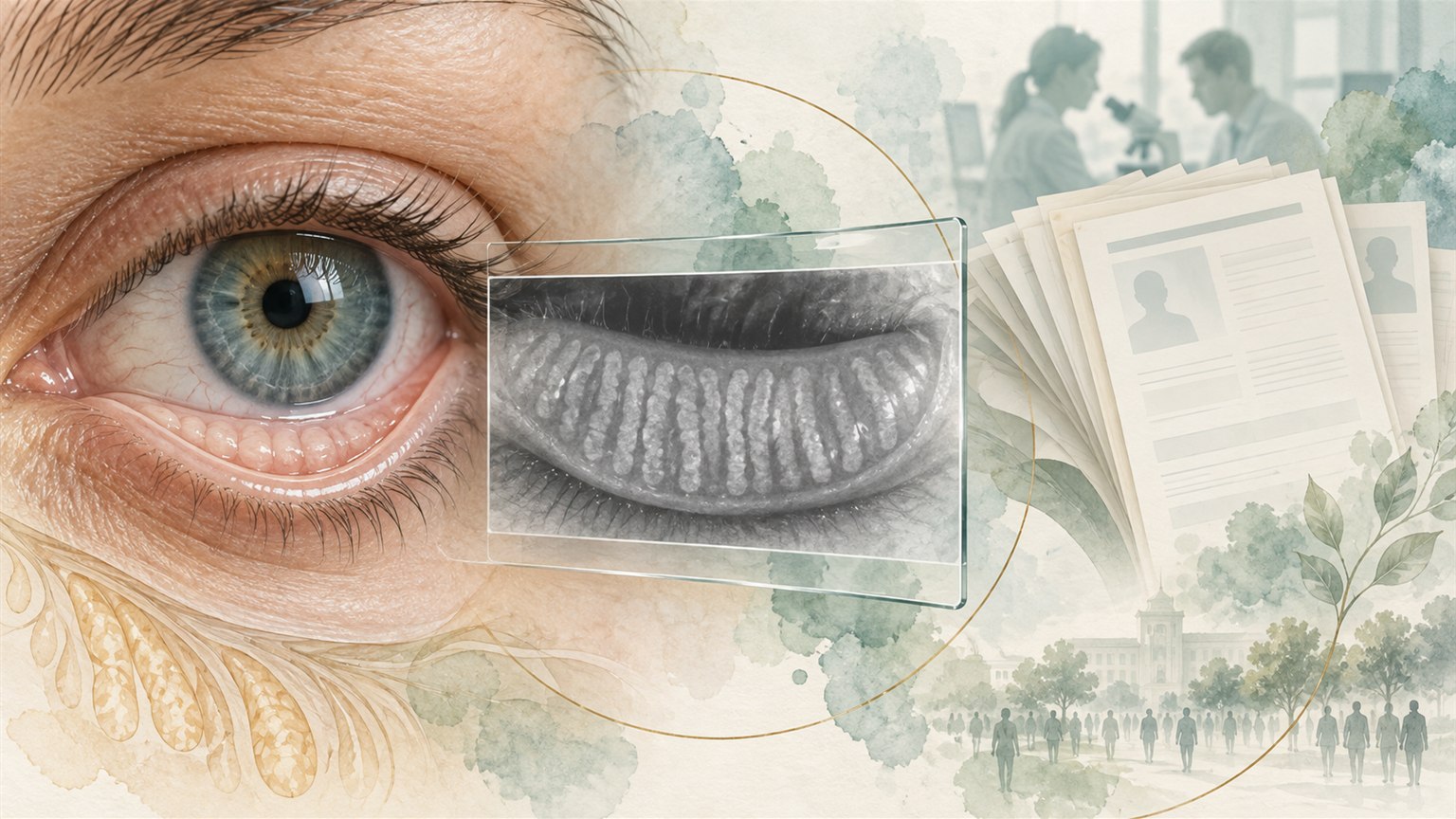
The 2019 picture
Three themes stand out:
- A 744-person cyclosporine trial improved tear production and staining, while its global symptom score did not separate from vehicle.
- Large U.S. and Indian records studies broadened estimates of diagnosed dry eye but also showed how much the answer depends on who reaches care.
- The DREAM study linked tear instability and meibomian findings with visual performance and tested how consistently gland images can be graded.
What the research shows
Large patient datasets and more detailed tear and eyelid measurements shaped the 2019 literature. Controlled trials found that symptoms and ocular-surface signs can respond differently. Population studies showed that prevalence estimates vary with diagnostic codes, questionnaire cutoffs, and access to care. These differences make patient selection and follow-up especially important when interpreting new markers or treatments.
Treatment studies
The stronger 2019 trials included vehicle or active comparators, but many asked about different signs and symptoms. Small studies of devices and short-term tear changes are useful leads, not estimates of lasting benefit for every patient.
-
Cyclosporine 0.09% in a phase 3 trial
After a vehicle run-in, 744 adults were randomized to nanomicellar cyclosporine 0.09% or vehicle for 12 weeks in a masked multicenter trial. A large Schirmer improvement occurred in 16.6% of treated patients versus 9.2% of controls, and surface staining also favored cyclosporine. Global symptoms improved by about 30% in both groups without a clear between-group difference.
-
A water-free cyclosporine formulation in phase 2
An exploratory study randomized 207 patients to two concentrations of water-free cyclosporine, its vehicle, or an open-label approved cyclosporine product for 16 weeks. Several staining measures favored the new formulation over vehicle, with an early signal in the central cornea. The approved-product arm was not masked, and multiple exploratory outcomes mean the apparent head-to-head advantage required confirmation.
-
A single diquafosol dose in evaporative dry eye
Researchers assigned eyes of 47 patients with dry eye and meibomian gland dysfunction to one dose of diquafosol or artificial tears. Lipid-layer thickness rose for up to an hour and noninvasive breakup time improved for up to 90 minutes after diquafosol. The short physiologic comparison cannot establish sustained symptom relief or how repeated treatment would perform.
-
Preservative-free diquafosol after cataract surgery
Patients with preexisting dry eye undergoing cataract surgery were assigned to preservative-free diquafosol, preserved diquafosol, or preservative-free hyaluronate. Tear breakup and gland measures generally favored diquafosol over hyaluronate during follow-up; meibum quality favored the preservative-free version at one and three months. The study compared active drops after surgery, so it does not isolate surgery's effect or the benefit over no extra drops.
-
Combining gland probing with intense pulsed light
An assessor-masked trial randomized 45 people with difficult-to-treat obstructive meibomian gland disease to intense pulsed light, gland probing, or both. The combination had better short-term symptom and gland measures than either procedure alone, and symptom scores remained lower at six months. The groups were small and there was no sham procedure, so expectations and other care could affect the comparison.
-
Treating meibomian disease before cataract surgery
A randomized trial followed 120 cataract patients with moderate gland obstruction assigned usual postoperative care, added preoperative warming and lid care, or stronger postoperative anti-inflammatory care. The preoperative group had better gland and tear-stability measures at one month, with tear breakup still better at three months. The combined preparation prevents attribution to any one component and patients were not fully masked.
-
Three active dry-eye drops compared
In an evaluator-masked, multicenter study, 227 patients were randomized to cyclosporine nanoemulsion, conventional cyclosporine emulsion, or diquafosol for 12 weeks. Nanoemulsion met the study's noninferiority target against conventional cyclosporine on combined surface staining, while secondary tear results varied between groups. With no vehicle arm, the trial chiefly compares available formulations rather than absolute efficacy.
-
Oral azithromycin versus doxycycline for persistent gland disease
A randomized comparison enrolled 115 patients with meibomian gland dysfunction that had not responded to conservative and topical care. More people assigned a short azithromycin course stayed stable after one treatment than those assigned a month of doxycycline, and early gastrointestinal complaints were less frequent. Treatment could be repeated or switched during nine months, complicating a simple long-term comparison.
-
Cyclosporine emulsion in a multicenter Chinese trial
A 12-week, double-masked phase 3 trial randomized 240 patients in China to 0.05% cyclosporine emulsion or vehicle while both groups also used unpreserved lubricant drops. A study-defined composite response and later symptom scores favored cyclosporine. The composite endpoint and shared lubricant use complicate comparisons with other trials, and follow-up does not establish longer-term benefit.
Population patterns and related conditions
The largest studies drew on claims, electronic records, or surveys. They describe different things: coded diagnoses, new clinic presentations, or reported symptoms. Their percentages should not be treated as interchangeable national prevalence figures.
-
Diagnosed dry eye in a large U.S. health system
Researchers analyzed claims and prescriptions for 9.7 million Military Health System beneficiaries over 2003–2015. The overall coded prevalence was 5.28%, higher in women and older adults, and annual recorded rates rose over time. The method captures diagnosed and treated disease within this health system; it can miss people who never seek care and may reflect changes in coding or access.
-
New dry-eye diagnoses in an Indian hospital network
Electronic records for more than 1.45 million new eye-care patients in India identified 21,290 recent-onset dry-eye diagnoses, about 1.46% of that network's presentations. Mixed, evaporative, and aqueous-deficient forms all appeared, with rates varying by age, residence, and work. Because the denominator is people visiting hospitals, these figures are not a direct estimate of incidence in India's general population.
-
Meibomian dysfunction and dry eye on a Japanese island
A population-based examination of 356 Takushima residents found meibomian gland dysfunction in 32.9%, dry eye in 33.4%, and both in 12.9%. Risk patterns differed: gland disease was linked more with age and male sex, while dry eye was linked more with female sex and contact lens wear. The small island sample and local case definitions limit generalization, but the limited overlap challenges treating the two labels as identical.
-
Sleep quality and dry-eye symptoms in Hangzhou
A community study surveyed 3,070 adults in Hangzhou about sleep and dry-eye symptoms. Poorer sleep scores were associated with worse OSDI scores after adjustment for measured factors. Both measures were questionnaires collected at one time, so the study cannot establish whether sleep affects the eyes, eye discomfort disrupts sleep, or another condition affects both.
-
An Ontario dry-eye questionnaire survey
An email survey of Ontario adults used the DEQ-5 to estimate symptom-defined dry eye, producing an age- and sex-adjusted figure of 21.3% from 5,163 completed responses. Women reported more symptoms than men. Only 4.1% of those contacted responded, and the threshold did not require an eye examination, so nonresponse and definition could substantially shift the estimate.
-
Air pollution and dry eye in Chinese eye clinics
A multicity study linked dry-eye diagnoses among 23,922 Chinese eye-clinic outpatients with recorded air-pollution measures and other factors. Ozone, fine particles, and sulfur dioxide showed associations, as did age, sex, surgery history, and medications. The very high dry-eye proportion reflects an ophthalmology-clinic sample; regional exposure and cross-sectional data cannot establish individual pollution causation.
-
Occupation in a large Dutch cohort
Among 40,501 employed adults in the Netherlands, reported dry-eye symptoms differed across occupational groups. Office-oriented jobs appeared higher risk after age and sex adjustment, but the pattern changed when many related medical conditions were also considered. Broad job titles cannot identify the actual exposure, such as screen time, airflow, or chemicals, and the survey cannot prove work caused symptoms.
-
Dry eye after refractive surgery in a large clinic database
A retrospective analysis of 25,317 people undergoing LASIK or PRK at one Israeli center identified clinically significant postoperative dry eye in 6%. Older age and some preoperative and procedure factors were associated with the outcome. The center's case definition, selection of procedure, and chart-based follow-up limit causal comparisons between LASIK and PRK or predictions for other clinics.
-
Migraine and dry-eye diagnoses in U.S. records
A case-control analysis of 72,969 patients in one U.S. health system found that people with a migraine diagnosis more often had a dry-eye diagnosis, with an adjusted odds ratio of 1.42. The large dataset supports a reproducible clinical association, while diagnostic codes and unmeasured conditions leave its direction and mechanism unresolved.
Vision, blinking, and diagnostic measures
These studies examined what common tests capture and how reproducibly newer images can be read. Many proposed cutoffs or combined rules were tested in the same groups used to develop them, so outside validation is still important.
-
Visual acuity and contrast in the DREAM cohort
A baseline analysis of 487 DREAM participants related standardized dry-eye findings to visual acuity and contrast sensitivity. Shorter tear breakup and worse meibomian secretions accompanied poorer contrast, while worse acuity tracked the vision part of the symptom questionnaire. The cross-sectional study links specific findings with performance but cannot show that treating a sign will improve vision.
-
Reading meibomian images in the DREAM study
Certified readers graded baseline meibography from 277 DREAM participants and compared image features with clinic scores and gland secretions. Agreement was moderate to substantial for most features, and dropout measures broadly tracked clinic grades, although images and grading varied. This work improves measurement standards, but gland appearance alone does not establish a patient's dry-eye subtype or symptoms.
-
Incomplete blinks as a dry-eye finding
A retrospective analysis of 58 dry-eye eyes used interferometry to count partial blinks and compared the results with symptoms, tear breakup, and meibomian loss. More incomplete blinking accompanied worse findings on several measures. Because the study observed patients at one point, it cannot tell whether altered blinking contributed to gland changes or arose in response to discomfort.
-
A six-question version of the OSDI
Researchers chose six items from the full OSDI using 264 responses, compared the shorter score with OSDI and DEQ-5 in another 120 people, and tested repeatability in 50. The OSDI-6 tracked the parent questionnaire and repeated reasonably well. Shared questions make that agreement partly expected; clinical accuracy against independent diagnoses and meaningful-change thresholds still need study.
-
Automated corneal-nerve analysis
Confocal images from 39 dry-eye patients and 30 controls were processed with automated nerve-measurement software. Several nerve features differed, and nerve width had the strongest individual discrimination in this sample. A combined rule was sensitive but poorly specific, so the imaging result is a research lead rather than a stand-alone diagnostic test.
-
Meibomian gland shape as a severity measure
A retrospective study compared meibography in 100 patients with meibomian gland dysfunction and 20 controls, measuring dropout, distortion, length, and density. Gland loss and distortion separated these selected groups, and distortion related to poorer secretion. The impressive diagnostic numbers were derived from clear cases and controls, so performance in borderline patients may be lower.
-
Handheld measurement of tear breakup
Fifty people, 31 with dryness symptoms, had repeated noninvasive breakup measurements with a handheld lipid-layer device and conventional fluorescein testing. The handheld readings separated symptomatic and other participants well in this small sample. Its proposed cutoff was selected from the same data, and symptoms alone were the comparison standard, so clinical diagnostic accuracy remains uncertain.
-
Where the tear film first breaks up
Keratography compared noninvasive tear breakup in 250 patients across dry-eye subtypes and 55 controls. Breakup was shorter and more often central or widespread in aqueous-deficient groups, while breakup time alone did not separate meibomian-only disease from controls. The patterns may add context to a full exam, but subtype labels and device measures require confirmation in other settings.
Tear, gland, and immune biology
Sequencing and molecular studies identified possible pathways behind dry eye and meibomian disease. A biological association, even when supported by laboratory work, is not yet a validated test or a proven treatment target in patients.
-
Neutrophil traps in ocular graft-versus-host disease
Ocular washings from patients with graft-versus-host dry eye contained neutrophil traps and related proteins, with heavier neutrophil findings accompanying more severe disease. Cell and mouse experiments explored tissue damage and found that heparin could dismantle the traps in the laboratory. The human samples support a mechanism to test, but the paper did not establish heparin drops as patient treatment.
-
Bacterial communities in meibomian gland dysfunction
Sequencing of conjunctival samples from 47 people with meibomian gland dysfunction and 42 controls found differences in bacterial composition, especially with severe gland disease. Staphylococcus was more abundant and related to gland-loss scores in the patient group. This observational snapshot cannot tell whether microbes contributed to gland disease or changed because the ocular surface was already altered.
-
The balance of wax and cholesterol esters in meibum
Nuclear magnetic resonance measurements of human meibum found a lower cholesteryl-to-wax ester ratio in samples from people with meibomian gland dysfunction than in normal donors. The ratio also varied by age, and the authors judged that this lipid difference alone was unlikely to explain tear-film stability. Donor comparisons offer chemical clues without linking one ratio to an individual patient's symptoms.
-
Tear proteins in stable Sjögren-related dry eye
A prospective case-control study compared tear-film findings and proteins in stable Sjögren dry eye with non-Sjögren dry eye. The Sjögren group had lower tear output and altered inflammatory and abundant-protein signals, including a higher MMP-9-to-lactoferrin ratio. These candidate monitoring markers need standardized collection and independent validation before use to guide care.
-
Tear factors, discomfort, and corneal immune cells
Investigators compared 47 people with evaporative dry eye and 33 controls using tear assays, symptoms, ocular tests, and corneal imaging. Several inflammatory and pain-related factors differed, as did tear vitamin D and dendritic-cell density. With many molecules tested in a modest cross-sectional sample, the signals are exploratory and do not establish that supplementation or pathway-targeted therapy would help.