Eye research / Dry eye / 2008
Dry Eye Research in 2008: 33 Notable Human Studies
Researchers tracked dry eye across populations and clinical settings, tested treatments, imaged meibomian glands, and refined patient-reported measures.
The 2008 picture
Three themes stand out:
- A ten-year follow-up in Beaver Dam found that about one in five initially unaffected older adults later reported dry eye.
- Large workplace and school surveys connected reported dryness with screen use and contact lenses, but their questionnaire definitions varied.
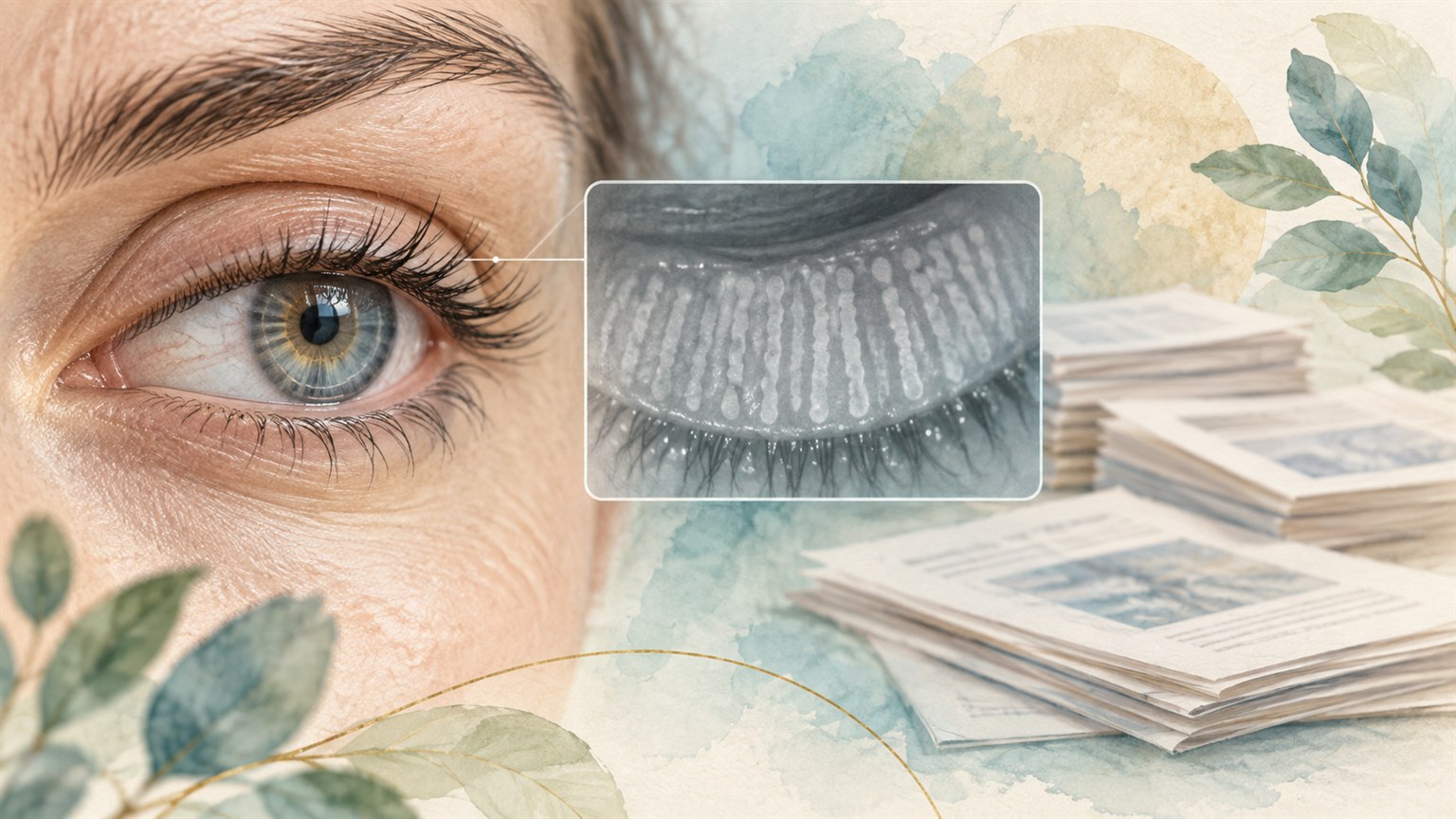
- Noncontact meibography and other studies made eyelid oil-gland structure and function more visible to researchers.
What the research shows
The 2008 evidence widened the frame of dry eye research. Large surveys showed symptoms in working-age adults, students, and several clinical populations; the Beaver Dam follow-up supplied a stronger longitudinal estimate in older adults. Meanwhile, gland imaging, tear physiology, and symptom instruments offered ways to describe the condition more precisely. Treatment comparisons were generally short, and observational results should remain separate from evidence of a causal treatment benefit.
Treatments and clinical care
Controlled comparisons offer the clearest short-term evidence for specific drops and plugs. Observational series describe care for harder cases, with greater uncertainty about cause and effect.
-
Cyclosporine in patients whose artificial tears had not helped
A prospective series followed 158 consecutive patients with mild to severe dry eye who began cyclosporine drops after inadequate relief from artificial tears. About 72% improved by the investigators' combined criteria during three to 16 months of follow-up. Without a comparison group or uniform follow-up time, the study cannot isolate cyclosporine's effect or compare it with other treatment options.
-
Evening primrose oil for contact lens-related dryness
A six-month, double-masked trial randomized 76 female soft contact lens wearers with dryness to evening primrose oil or olive-oil placebo. Reported dryness improved at three and six months, and overall lens comfort improved at six months; most objective surface and tear measures did not separate the groups. The findings concern this specific supplement and contact lens population, not all dry eye.
-
Hypotonic versus isotonic hyaluronate drops
Twenty-eight dry-eye patients used preservative-free 0.4% hyaluronate at two different osmolarities in a randomized, single-masked crossover study. After seven days per formulation, symptoms and surface-cell measures favored the hypotonic drops. The sample was small and the one-day washout brief, so carryover and longer-term differences remain uncertain.
-
Minocycline plus lid care for meibomian gland dysfunction
Twenty patients with meibomian gland dysfunction received lid hygiene alone or with oral minocycline for eight weeks. Tear breakup time improved in the combined-treatment group, and one measured meibomian fatty acid changed more than with hygiene alone. The ten-person groups and limited treatment description make this a signal for further study rather than proof of a preferred antibiotic regimen.
-
Carbomer compared with sodium hyaluronate
A month-long, double-masked randomized study compared carbomer and sodium hyaluronate drops in 65 people with moderate dry eye. Both reduced reported irritation and staining; hyaluronate produced somewhat better surface staining scores and less prolonged blur. Neither treatment produced a lasting improvement in tear breakup time, and the trial was too short to assess persistent benefit.
-
Longer-term use of a patient's own serum drops
A chart review of 23 patients with difficult-to-treat dry eye found that many reported less discomfort and lubricant use after starting their own serum drops, with less corneal staining in 34 of 46 eyes. Follow-up averaged 17 months. Because the review had no comparison group and included both eyes from patients, it cannot establish how much improvement was due to the drops.
-
Punctal plugs for short tear-breakup time
A prospective series assessed 27 patients before and one month after punctal plug insertion. Nineteen were satisfied with symptom relief, and a measure of sustained visual acuity improved in eyes without excess tearing; it worsened in eyes that developed excess tearing. This uncontrolled study highlights a practical tradeoff rather than proving that plugs help every patient with rapid tear breakup.
-
SmartPlug versus silicone punctal plugs
Thirty-six dry eyes were randomized to a SmartPlug or a silicone plug and followed for about 11 weeks. Symptoms, tear breakup time, and staining improved in both arms, with no clear between-device advantage in those measures. The short follow-up and eye-level sample limit conclusions about long-term retention, complications, and relative benefit.
-
Long-term follow-up after salivary gland transfer
Researchers surveyed 32 people after submandibular gland transfer for severe keratoconjunctivitis sicca and clinically revisited 11 of them five to ten years later. About two-thirds reported lasting subjective benefit, while the examined ocular surfaces remained stable. This specialized surgery was studied in a highly selected group without an untreated comparison, and the long-term examined sample was small.
-
An eye-warming mask for meibomian gland dysfunction
A prospective comparison examined 20 people with meibomian gland dysfunction and 22 healthy controls during short and two-week eye-mask use. The tested warmer was associated with better tear and surface measures and fewer symptoms in the patient group. The small study and limited detail on treatment allocation make its apparent advantage over conventional warming uncertain.
Who reported dry eye and what was associated with it
Population, workplace, and clinical surveys found different rates because they sampled different people and used different definitions. Environmental experiments studied short-term changes rather than disease incidence.
-
Ten-year dry-eye incidence in Beaver Dam
Of 2,414 Beaver Dam participants who had not reported dry eye at the initial assessment, 482 reported it during ten years of follow-up, an estimated 21.6% cumulative incidence. New reports were more common with older age and in women; several health and medication associations also appeared. As in the earlier five-year report from this cohort, the outcome relied on reported history rather than a uniform dry-eye examination.
-
Ocular surface symptoms in glaucoma care
A cross-sectional study of 101 glaucoma or ocular-hypertension patients found frequent dry-eye symptoms and abnormal tear tests. Each additional benzalkonium-chloride-containing drop was associated with higher odds of surface staining after age and sex adjustment. The study raises concern about medication burden, but it cannot separate the effect of preservatives from disease severity or other differences in care.
-
Dry eye among Japanese screen workers
More than 3,500 Japanese office workers using display terminals answered an emailed survey. Reported dry-eye diagnosis or severe symptoms was more common in women, contact lens wearers, and those using screens over four hours daily. The large sample adds weight to the association, while self-report and cross-sectional timing prevent a causal conclusion about screen use.
-
Dry-eye findings in a type 2 diabetes clinic
Among 199 consecutively selected people at a diabetes center, 54% met the investigators' dry-eye definition based on Schirmer and tear breakup tests. Findings were associated with longer diabetes duration and diabetic retinopathy. This is a clinic sample with a particular test definition, so the percentage is not a population estimate for everyone with diabetes.
-
Dry-eye symptoms in Japanese high school students
A questionnaire survey of 3,433 students aged 15 to 18 found prior dry-eye diagnoses in 4.3% of boys and 8.0% of girls, while severe symptoms were much more common. Girls and contact lens wearers reported more problems. The study shows that dryness was not confined to older adults, but its single-school setting and self-reported outcomes limit wider prevalence claims.
-
Dry-eye symptoms at high altitude in Tibet
A population-based survey analyzed 1,840 Tibetan adults aged 40 or older. Just over half reported at least one frequent dry-eye symptom, with higher altitude, age, and socioeconomic factors associated with the study's symptom-based definition. Clinical signs were less frequent and did not define every symptomatic case; the striking percentage should not be read as a universal rate of clinically confirmed disease.
-
Ocular surface differences in chronic smokers
A comparison of 15 long-term smokers and 20 nonsmokers found shorter tear breakup time, slower lipid spread, greater evaporation, and inflammatory and goblet-cell changes in the smokers. The findings are consistent with an adverse ocular-surface effect of smoke, but the small observational groups cannot fully separate smoking from other differences between participants.
-
Short passive-smoke exposure changed tear measures
Twelve healthy nonsmokers were measured before and after five minutes in a controlled smoke chamber. Tear stability and staining worsened, and inflammatory and oxidative markers rose by the next day. The within-person experiment supports an immediate surface response to smoke, but it does not quantify the risk of chronic dry eye from ordinary secondhand exposure.
-
Contact lens wear and tear evaporation
Tear evaporation was compared across current contact lens wearers, lens wearers who had not worn lenses that day, and nonwearers at two humidity levels. Evaporation was highest with lenses in place and remained higher in former-day wearers than in nonwearers. The large cross-sectional comparison supports a physical link with lens-related dryness, while participant differences may also contribute.
Measuring glands, symptoms, vision, and tears
These investigations advanced practical ways to see the meibomian glands and evaluate the tear film, while showing that symptom scales and biomarkers need careful interpretation.
-
Noncontact infrared imaging of meibomian glands
Researchers imaged upper and lower eyelid glands in 236 healthy people aged four to 98 without pressing a light probe against the lid. Gland loss increased with age and related to lid-margin findings. This influential method made gland structure easier to document, though the cross-sectional data did not show whether a given person's glands would deteriorate over time.
-
Standardized gland expression and dry-eye symptoms
In 133 people attending routine eye exams, the number of lower-lid meibomian glands that released liquid oil correlated with dry-eye symptoms. Expression also varied sharply by lid location, with far fewer productive glands temporally than nasally. The results support a consistent testing location and pressure, but this cross-sectional sample did not establish a diagnostic cutoff.
-
Corneal nerve changes in primary Sjögren syndrome
Twenty people with primary Sjögren syndrome and ten matched controls had corneal sensitivity testing and confocal nerve imaging. The patient group showed greater mechanical sensitivity and altered nerve shape, but not a clear difference in nerve density. The small comparison suggests a possible nerve and inflammatory contribution to discomfort, without proving that the observed structures cause pain.
-
Optical quality after a blink
A wavefront sensor tracked optical aberrations for 30 seconds in 20 dry eyes while participants blinked at set intervals. Eyes with central superficial punctate keratopathy had consistently greater aberrations than dry eyes without central staining. The study links surface damage with optical quality, though it was small and did not directly measure everyday visual tasks.
-
How tear volume affects lipid-layer spread
Video measurements in 29 eyes from 22 people compared the postblink spread of the tear-film lipid layer with tear-meniscus size. Lower tear volume was associated with slower initial lipid spread, providing a plausible connection between aqueous deficiency and an unstable outer layer. The small physiologic study suggests a measurement target rather than a validated clinical test.
-
Confocal imaging of meibomian gland dysfunction
In vivo confocal microscopy compared 20 patients with meibomian gland dysfunction and 15 controls. Patient glands had fewer and larger visible secretory units, and those imaging measures related to gland dropout and expression grades. This preliminary diagnostic work needs replication and agreed measurement standards before its images can guide routine decisions.
-
Four dry-eye symptom questionnaires compared
Ninety-seven people not wearing contact lenses completed four symptom questionnaires in random order. Three established instruments produced broadly related scores and separated self-described symptomatic from asymptomatic groups; a brief three-question tool also looked useful for screening. Because the groups were defined by a symptom question, the study was not an independent test of clinical diagnosis.
-
What change in the IDEEL symptom score may matter
Seventy-four dry-eye patients assigned to one of three marketed tear replacements completed the IDEEL symptom-bother scale and rated overall change over four weeks. A score shift of about 12 points best matched self-reported meaningful improvement in this sample. The threshold is an estimate tied to the study's patients and anchor question, not a universal rule for every trial.
-
Tear proteins in Sjögren and non-Sjögren dry eye
Tears from 25 Sjögren patients, 25 non-Sjögren dry-eye patients, and 26 controls were tested for total protein, lipocalin, and lysozyme. The Sjögren group had less total protein and lipocalin, while lysozyme did not clearly differ. These biochemical differences are interesting, but the cross-sectional data do not validate a stand-alone bloodless diagnostic test.
-
Tear osmolarity led a small comparison of diagnostic tests
Investigators measured tear turnover, evaporation, osmolarity, and other tear features in 41 people with dry eye and 32 controls. Osmolarity performed best as a single measure in this sample; a weighted combination of three tear measures classified participants more accurately. The cutoffs and composite rule were developed and tested in the same small groups, so independent validation is needed before general use.
-
Blink experiments linked smaller tear menisci with unstable tears
In 15 dry-eye patients and 15 controls, investigators recorded tear meniscus height and fluorescein breakup after coached partial and full blinks. Both menisci were smaller in the dry-eye group, and its tear film showed more breakup after full blinks than after partial blinks. This small physiology experiment used instructed blinking and did not test whether changing blink behavior improves symptoms.
Dry eye after refractive surgery
Two small surgical cohorts examined whether baseline tear function and flap design related to postoperative dry-eye measures.
-
Baseline tear volume and chronic dryness after LASIK
A prospective study tracked 24 LASIK patients from before surgery to nine months afterward. Those classified with chronic dry eye at nine months had lower preoperative Schirmer wetting and slower recovery in several surface measures. The result points to baseline tear volume as a possible risk marker, but the tiny cohort cannot establish a reliable prediction rule.
-
Thin femtosecond flaps and tear recovery
A retrospective series followed 72 eyes of 38 patients for six months after LASIK with thin femtosecond flaps. Corneal sensitivity dipped early and returned toward baseline, while measured tear function changed little overall. Without a comparison flap design, the study cannot show that thin flaps prevented dry eye, despite the favorable recovery in this group.
-
A lubricant modestly improved one tear measure after LASIK
A double-masked trial assigned opposite eyes of 30 LASIK patients to a lubricant or saline drops for 30 days. At two weeks, tear breakup time was about one second longer with the lubricant, while other measured outcomes were similar and no adverse events were reported. The small, short study does not establish a meaningful advantage for lasting post-LASIK dryness.