Everyday wellness
Incomplete Blinking: Why Partial Blinks Can Leave Eyes Dry
In an incomplete blink, the eyelids don't fully meet, so part of the eye misses fresh tears. What research found about screen reading and how to blink fully.
What is an incomplete blink?
An incomplete blink is a blink in which the upper eyelid does not meet the lower eyelid. A full blink helps spread tears across the eye surface, as the American Optometric Association explains. Read the AOA explanation of complete and incomplete blinks.
You may also see it called a partial blink. Because a blink is over in a fraction of a second, it's hard to tell whether your own blinks are complete.
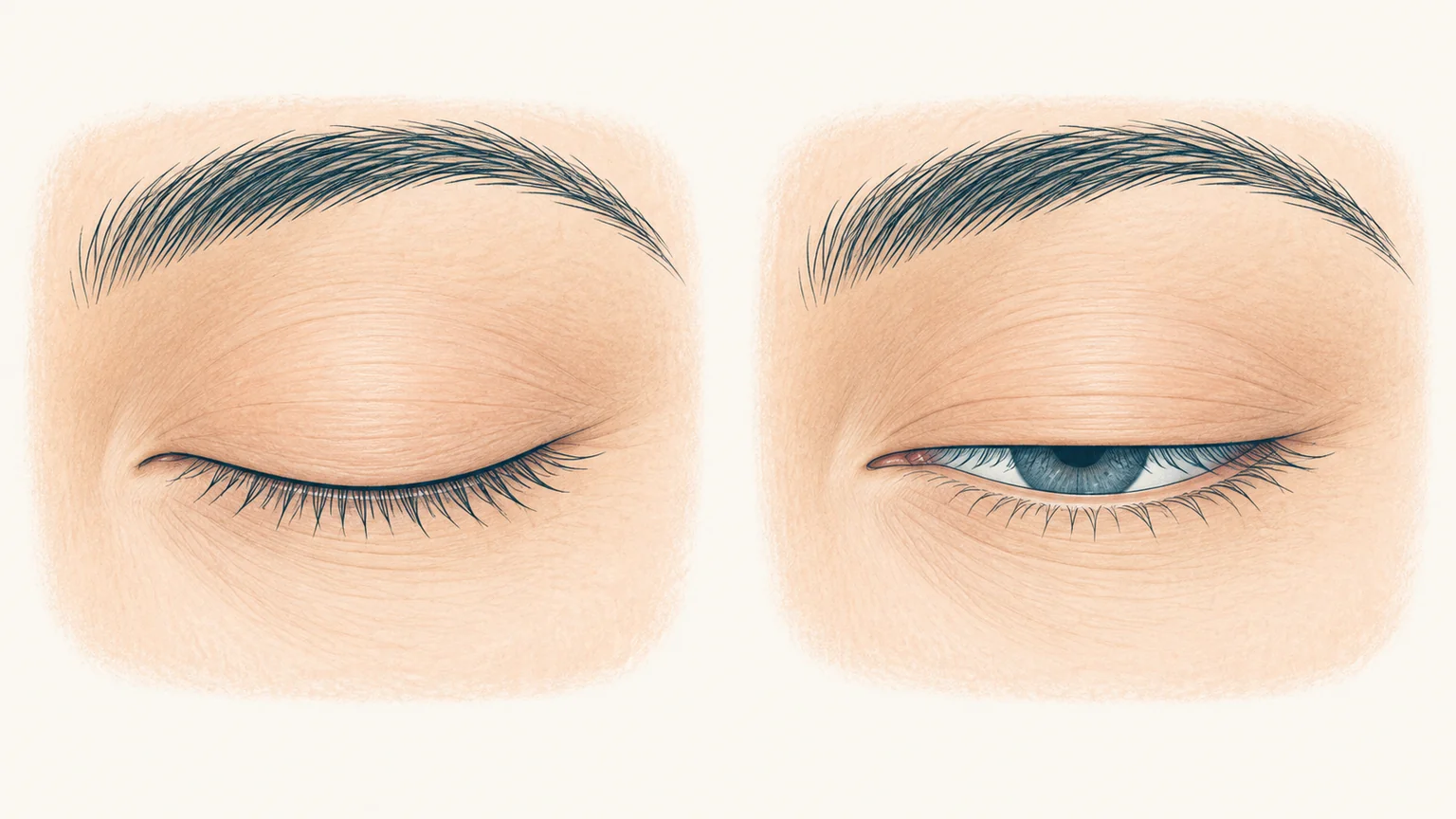
- Complete blink
- Incomplete blink
A complete blink brings the eyelids together; an incomplete blink leaves a gap.
Why complete blinks matter
A full blink helps spread a fresh tear film across the front of the eye. This thin covering keeps the surface moist and smooth, while its oily component helps keep tears from evaporating too quickly. Read how the tear film works.
When the eyelids stop short of meeting, part of the eye surface may miss that fresh covering. Several incomplete blinks in a row can leave the lower part of the eye exposed to drying for longer between full blinks. As tears evaporate, these areas can become more prone to dryness and discomfort. Read about incomplete blinking and tear-film drying.
Faster evaporation is the core of evaporative dry eye, which our separate guide explains in more detail. Learn about evaporative dry eye.
What happens during screen reading
A study of 32 healthy young adults found that computer reading was associated with fewer blinks and a higher proportion of incomplete blinks than looking at a target 3 meters away. Read the study on blink rate and incomplete blinks.
Researchers recorded the right eye with an infrared eye tracker at 250 frames per second, analyzing the last 150 seconds of each 15-minute task. During computer reading, participants averaged 9.8 blinks per minute, and more than half of their blinks were incomplete.
| Condition | Mean blink rate (blinks per minute) | Mean incomplete blinks (% of all blinks) |
|---|---|---|
| Looking at a target 3 meters away (control) | 20.4 | 37.9% |
| Computer reading | 9.8 | 56% |
Source: Talens-Estarelles C, Esteve-Taboada JJ, Sanchis-Jurado V, Pons ÁM, García-Lázaro S (2022). Blinking kinematics characterization during digital displays use. Graefe's Archive for Clinical and Experimental Ophthalmology, 260(4), 1183–1193.
The participants were young adults without dry eye disease, and the study measured short-term blink behavior rather than whether anyone went on to develop dry eye. It included no matched paper-reading condition, and the authors note that further studies are needed to confirm their findings.
See an incomplete blink in motion
Our interactive tear film animation lets you set how often blinks are incomplete and how far the eyelid travels. Watch which part of the eye stops being refreshed and how the tear film thins there until the next full blink. Open the tear film animation.
How blink tracking encourages conscious blinking
BlinkEasy aims to count primarily complete blinks. It tracks your blink rate during screen time, helping you notice changes during focused work. Its reminders encourage conscious blinking, prompting you to let your eyelids close fully and comfortably. Try BlinkEasy free for 14 days.
Use reminders for comfortable blinking
When BlinkEasy reminds you to blink, look away from the screen and let your eyelids close and reopen comfortably, without squeezing. Our blinking-break guide offers a short routine to follow when prompted. Try a simple blinking break.
The AOA suggests a simple habit: every once in a while, fully open and close your eyes. Read the AOA tip on complete blinks.
Talking to an eye care professional
At an eye exam, it can help to mention your screen habits. An eye doctor can examine your eyelids and tear film with a slit lamp microscope and check how well your tears cover the eye. See how eye doctors examine the tear film.