Everyday wellness
How to blink more - Blinking exercises for Dry Eye
Learn simple blinking exercises for dry eyes, why you forget to blink when you concentrate, and how BlinkEasy reminds you to blink fully at the computer.
The most useful blinking habit is a complete, comfortable blink: let your upper and lower eyelids meet, then open your eyes again naturally. During focused computer work, a reminder can help you make room for those full blinks. BlinkEasy combines blink-rate tracking with prompts to blink and take screen breaks, so you don't have to rely on memory alone.
Why am I not blinking enough?
Sustained concentration can change the way you blink. When you're absorbed in reading, working, or gaming, you may blink less often or make partial blinks that stop before your eyelids meet. Screens aren't the only trigger: in one study, people also blinked less while reading on paper, so the demands of the task matter as well as the device. See the study comparing blinking during different reading tasks.
Blinking too little and blinking incompletely are two different problems. In a study of 25 people who read the same text on a screen and on paper, average blink rates were similar, but more of the blinks at the screen were incomplete. That's why a blink count alone can't tell you how well your tears are covering your eyes. Read the screen-versus-paper study. Learn about incomplete blinking.
Why do I keep forgetting to blink?
Most everyday blinking happens automatically, so you don't have to remember each blink. What's easy to forget is the deliberate part: the pause or exercise you planned to do, right when your attention is on something else. See how automatic and intentional blinks differ.
A reminder gives you the cue at the moment you need it. A sticky note or a timer can help, and BlinkEasy can prompt you when your measured blink rate falls below the target you set. Use each prompt for a short pause and a few full blinks instead of trying to keep track of every blink all day.
Should I blink more if I have dry eyes?
Regular, complete blinking may help, especially if focused screen work reduces your blinking. Each full blink helps spread tears across the surface of your eye. But a higher count alone isn't the goal: several quick, partial blinks can still leave part of that surface exposed. Read the AOA explanation of complete blinking.
Dry eye has several causes, including making too few tears and tears that evaporate too quickly. Blinking exercises can complement artificial tears and other treatments your eye doctor recommends. They don't address every cause of dry eye, and no single blink-rate target suits everyone. See the National Eye Institute guide to dry eye.
Commonly recommended blinking exercises
The routines below share three elements: full eyelid closure, short practice sessions, and regular cues. Start with comfortable, complete blinks. If your eye doctor has given you a specific exercise, follow that technique and schedule instead.
1. Gentle complete blinks
- Pause what you're doing and relax your forehead, face, and shoulders.
- Gently close both eyes until your eyelids meet. Don't squeeze or scrunch up your face.
- Keep your eyes closed for a moment, then open them naturally.
- Repeat a few times at a comfortable pace, then return to your task.
The point is to practice closing your eyes completely, not to see how fast or how hard you can blink. Keep your hands away from your eyes.
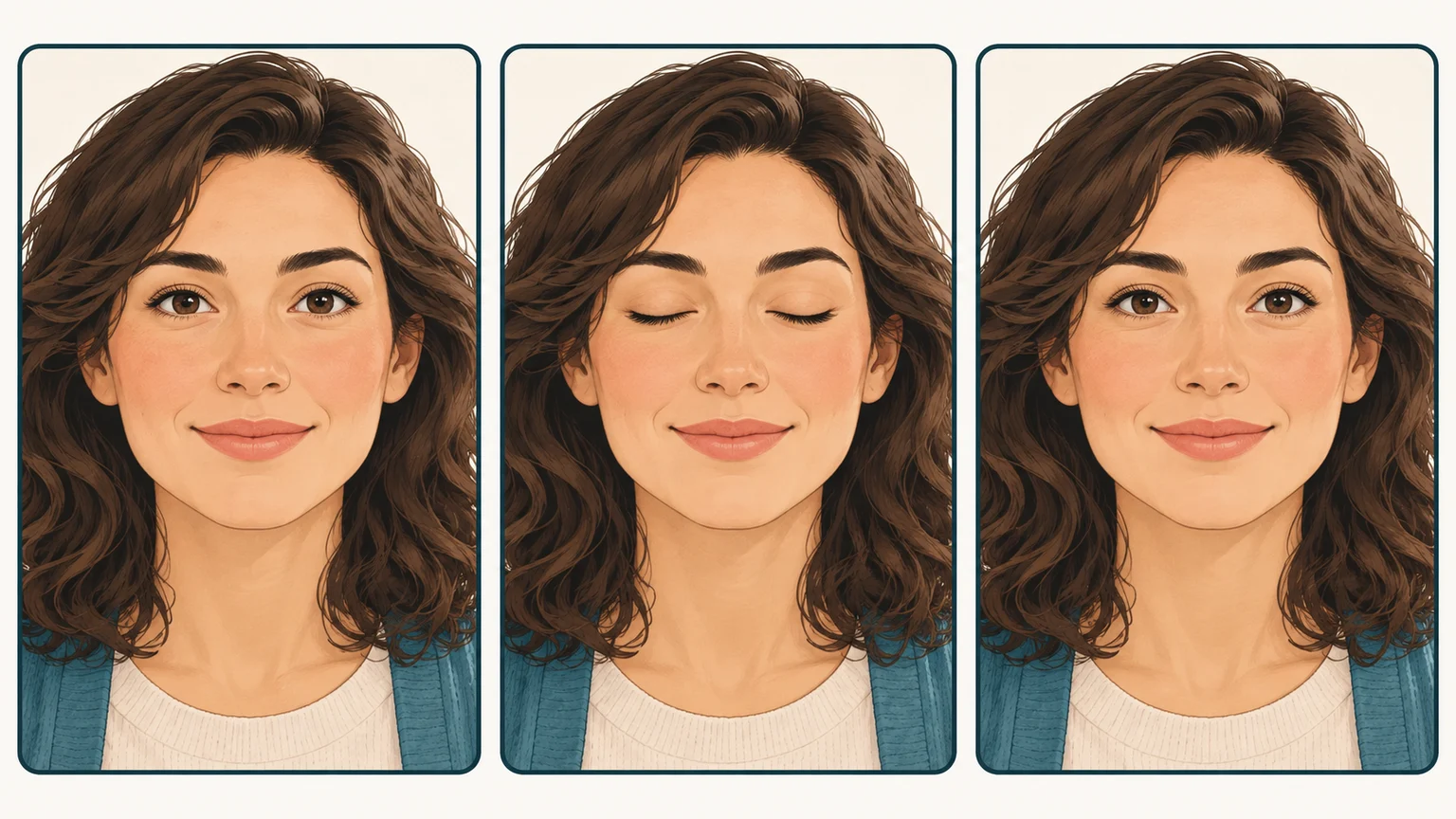
- Open naturally
- Close completely
- Reopen gently
Let your eyelids meet comfortably before you open your eyes again, and keep your face relaxed.
2. The close–open–close–squeeze sequence
A commonly taught variation closes the eyes twice and adds a squeeze the second time. One published study used this sequence:
- Close both eyes normally for two seconds, then open them.
- Close them normally again for two seconds.
- With your eyes still closed, squeeze your eyelids together for two seconds, then open them.
In that 2021 study, participants repeated the roughly 10-second cycle every 20 minutes during waking hours for four weeks. The 41 people who completed it reported fewer symptoms, made fewer incomplete blinks, and showed a modest improvement in tear stability. Because the study had no untreated comparison group, it can't show how much of the improvement came from the exercise itself. Read the blinking-exercise study.
Squeezing is part of some clinician-taught routines, but you don't need it for the gentle exercise above. Ask your eye doctor whether to include it and how firmly to squeeze. Avoid squeezing hard, rubbing your eyes, or pressing on your eyeballs. Stop if an exercise causes pain, and get guidance before trying a squeeze routine after eye surgery.
3. Scheduled close–squeeze–open sets
Some routines group the exercises into a few daily sessions instead of repeating one cycle throughout the day. A 2025 study compared several schedules and followed up with a smaller efficacy study. Fifteen close–squeeze–open cycles, three times a day for two weeks, improved symptoms and reduced incomplete blinking, although several tear-film measurements did not improve. Most of the benefits faded once people stopped practicing. This is one schedule that has been studied, not an established best routine for everyone. Read the study of blink-exercise schedules.
4. Complete blinks during 20-20-20 breaks
Every 20 minutes, look at something about 20 feet away for 20 seconds, and use the break for a few gentle, complete blinks. Checking your phone keeps your eyes focused up close, so pick something in the distance instead. See the AAO screen-break advice.
The 20-20-20 rule is a practical reminder, not a proven dry-eye treatment, and you don't need to hit the exact numbers. Studies of those specific break intervals have had mixed results. Read a study that found symptom improvement. Read a study that found no symptom benefit.
How do I make myself blink more?
Pick one cue and one simple response to it. For example, when a BlinkEasy reminder appears, finish your sentence, look away from the screen, and make a few relaxed, complete blinks. You can also tie your practice to something you already do, such as sending an email or finishing a page.
- Put a small reminder near your screen, where you'll notice it.
- Use blink-rate reminders during focused work and a separate timer for any scheduled exercise your eye doctor recommends.
- Keep each pause easy enough to repeat. A short routine you actually follow beats a complicated one you forget.
- Focus on comfort and full closure rather than chasing a higher number on a counter.

A visible cue or a BlinkEasy prompt can remind you to look away and make a few complete blinks.
How BlinkEasy helps you blink more
Knowing an exercise is only part of building a habit. The harder part is remembering it while computer work has your full attention, and that's where BlinkEasy helps. The app runs on Windows and Mac and uses a built-in or USB webcam to track your blink rate.
- Notice when your blinking slows down. Blink-rate tracking helps you spot changes during focused screen work.
- Get a cue to blink. BlinkEasy reminds you when your blink rate falls below the target you set. Treat each reminder as a cue for a few comfortable, complete blinks.
- Schedule your practice. Custom periodic or daily timers show a reminder message you write yourself, such as "Pause and make a few complete blinks." Use a timer for an exercise schedule your eye doctor has prescribed, and screen-break reminders for pauses away from the display.
- Review your routine. Printable reports make it easier to discuss your blinking and screen habits with your eye care professional. Webcam images are processed on your computer, and your blink data and reports stay on your device.
BlinkEasy provides tracking and reminders. It doesn't diagnose dry eye, and it can't confirm that an exercise is treating it. Pair its prompts with the technique and care that work for you.
Make complete blinking part of your workday. Try BlinkEasy free for 14 days. No subscription or credit card required.
When to get your eyes checked
Schedule an eye exam if dryness persists or interferes with your day, or if your eyelids don't close fully. Get urgent medical care for a painful red eye, strong light sensitivity, sudden vision changes, or a red eye while wearing contact lenses. For sudden loss of vision, seek emergency care immediately. See guidance on symptoms that need medical attention.