Screen comfort
Meibomian Gland Dysfunction (MGD): A Plain-English Guide
In MGD, the oil glands in your eyelids don't supply the tear film as they should. What the glands do, how MGD relates to dry eye, and how eye doctors check it.
Meet the glands in your eyelids
Meibomian gland dysfunction (MGD) means the oil glands along the edges of your eyelids aren't working as they should. When they release too little oil, or oil that has changed, the watery part of your tears can dry out faster.
Meibomian glands are small glands in the eyelids that supply oil to the tear film. This oil helps limit evaporation of the watery part of tears. Their openings lie along the eyelid edges. Read the Association of Optometrists introduction to MGD.
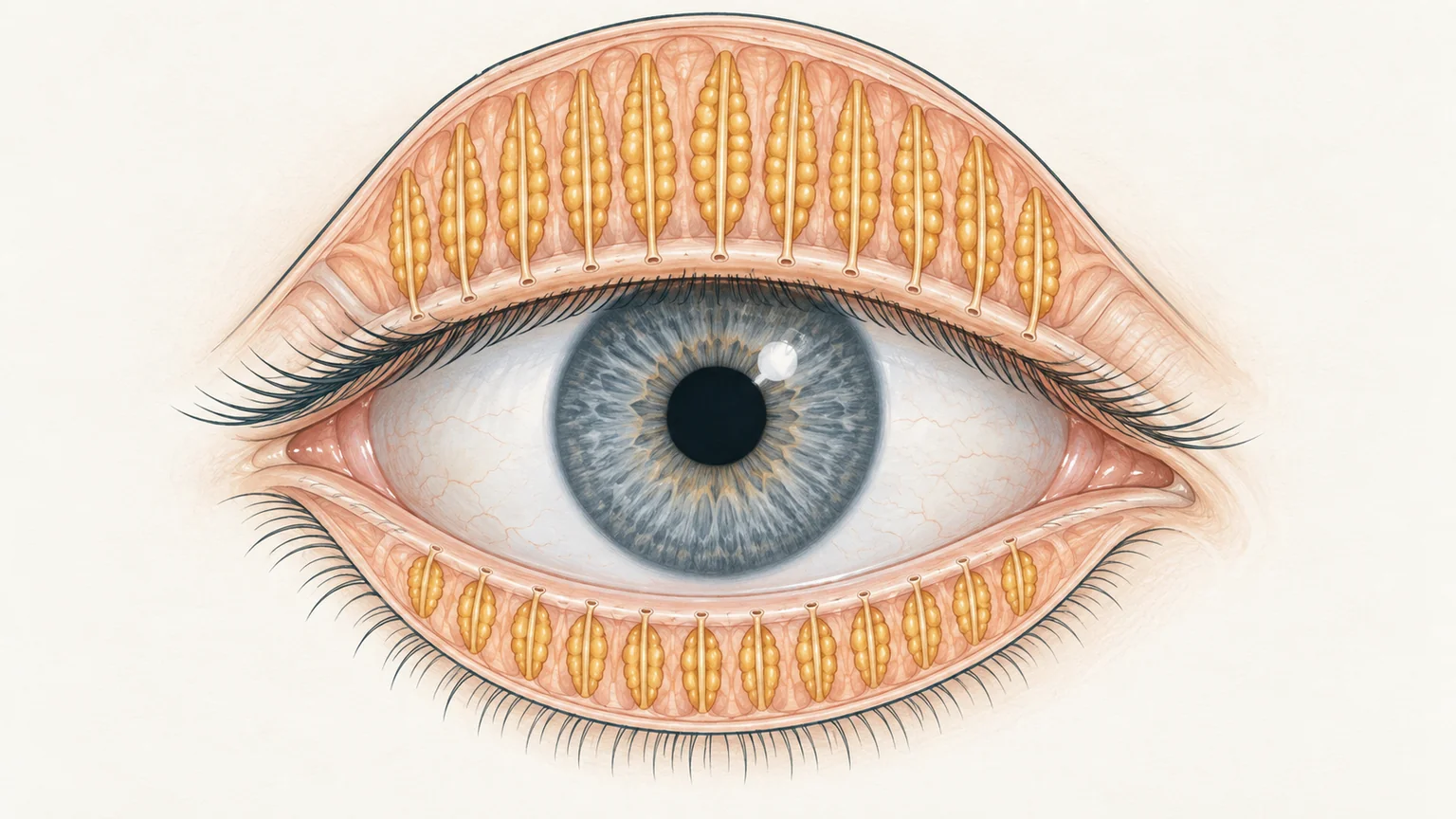
Meibomian glands lie inside the eyelids and open along the lid edges. Simplified view.
The Association of Optometrists describes MGD as a common condition. When the glands become blocked, the eyelids can feel sore or look swollen, and drying eyes can feel itchy or gritty.
What changes in MGD?
MGD is a persistent problem with how the meibomian glands work. According to the TFOS definition, it commonly involves blocked ducts or changes in the quality or amount of oil the glands release. See the TFOS definition of meibomian gland dysfunction.
In practice, that can mean gland openings plugged with thickened oil, or oil that no longer spreads well over the tears. Either way, less of it reaches the tear film.
Who is more likely to have MGD?
MGD becomes more common with age. The Association of Optometrists notes that it is more likely after 50 and in people with diabetes or oily skin conditions. Read the AOP guide to MGD (PDF).
The American Academy of Ophthalmology's EyeWiki also lists contact lens wear and certain medicines, including isotretinoin for acne, antihistamines, and antidepressants, among the factors associated with MGD. See the AAO EyeWiki overview of MGD.
A risk factor does not mean you have MGD. EyeWiki also notes that MGD without symptoms is far more common than MGD with symptoms, which is one reason an eye exam matters more than a checklist.
How does MGD relate to dry eye?
MGD can contribute to evaporative dry eye by changing the supply of oil to the tear film. Other factors can also cause tears to evaporate too quickly. Read the TFOS explanation of evaporative dry eye.
Our guide to evaporative dry eye explains how the tear film loses water between blinks and what can speed that up at your desk. Read about evaporative dry eye.
Where blinking fits into the picture
Blinks help spread the oil supplied by the meibomian glands across the tear film. See how blinking redistributes the tear film.
A complete blink brings the eyelids together and helps spread a fresh tear film across the eye. Incomplete blinks can leave part of the surface without that fresh covering. Read about the benefits of complete blinking.
Our interactive tear film animation includes a Glands view that follows the oil from the meibomian glands to the tear film. Slow it down to compare what happens after complete and incomplete blinks. Open the tear film animation.
How an eye doctor checks the glands
An eye doctor can examine the edges of your eyelids under a slit lamp microscope and look at the gland openings. Gentle pressure on the eyelid shows whether the glands release oil and what that oil looks like. Some practices also photograph the glands with infrared light, a technique called meibography. Read how eye doctors assess MGD.
If you have questions about your eyelids or dry-feeling eyes, an eye care professional can explain what an exam shows and which care options suit you.
Support complete blinking during screen work
BlinkEasy tracks your blink rate through your webcam and reminds you when it drops during focused work. Treat each reminder as a cue for a few slow, complete blinks, letting your eyelids meet without squeezing. Try BlinkEasy free for 14 days.
For a closer look at the difference between complete and incomplete blinks, our guide explains how the eyelids spread tears across the eye. Understand complete and incomplete blinks.