Screen comfort
Can Dry Eyes Cause Watery Eyes?
Yes. When dryness irritates the eye, it can respond with extra tears. Why that happens, what else causes watery eyes, and what an eye exam can show.
Visible tears are only part of the picture
Yes, dry eyes can water. When the surface of the eye dries out and becomes irritated, your eyes can respond by making extra tears. Mayo Clinic lists watery eyes among the symptoms of dry eye and describes them as the body's response to that irritation. Read the Mayo Clinic overview of dry eyes.
The National Eye Institute explains that blinking spreads a thin tear film over the eye. Its watery, oily, and mucus components have different roles, including keeping the surface moist, slowing evaporation, and helping the film stay on the eye. Explore the NEI explanation of how tears work.

Visible tears alone do not show how well the tear film is working.
Why irritation can bring more tears
The American Academy of Ophthalmology explains that irritation from dry eye can trigger extra tear production. Its patient guide lists watery eyes among possible dry-eye symptoms. Producing a burst of tears therefore does not necessarily mean the usual tear film is working well. Read the AAO dry-eye patient guide (PDF).
As the AAO puts it on its patient website, having a lot of tears with dry eye might sound odd, but your eyes make more tears when dry eye irritates them. Read the AAO overview of dry eye.
Why extra tears do not fix dryness
These extra tears, often called reflex tears, add volume for a moment. They do not change what made the surface dry in the first place. If tears evaporate too quickly between blinks, for example, a burst of tears can spill over or drain away, and the dry feeling can return once it has passed.
That is why the tear film's makeup matters as much as the amount of tears. Its oily outer layer comes from small glands along the edges of your eyelids and slows evaporation between blinks. Learn why tears can evaporate too quickly. Meet the oil glands in your eyelids.
Watering can have other explanations
Dry eye is one possible explanation for watering. The NHS also describes causes such as wind or smoke, allergies, and problems with tear drainage. Those possibilities are why watering alone cannot identify what is happening. Read the NHS overview of watering eyes.
Mayo Clinic groups the causes of watery eyes into several categories, from allergies, infections, and blocked tear ducts to eyelid problems and certain medicines. See the Mayo Clinic list of causes.
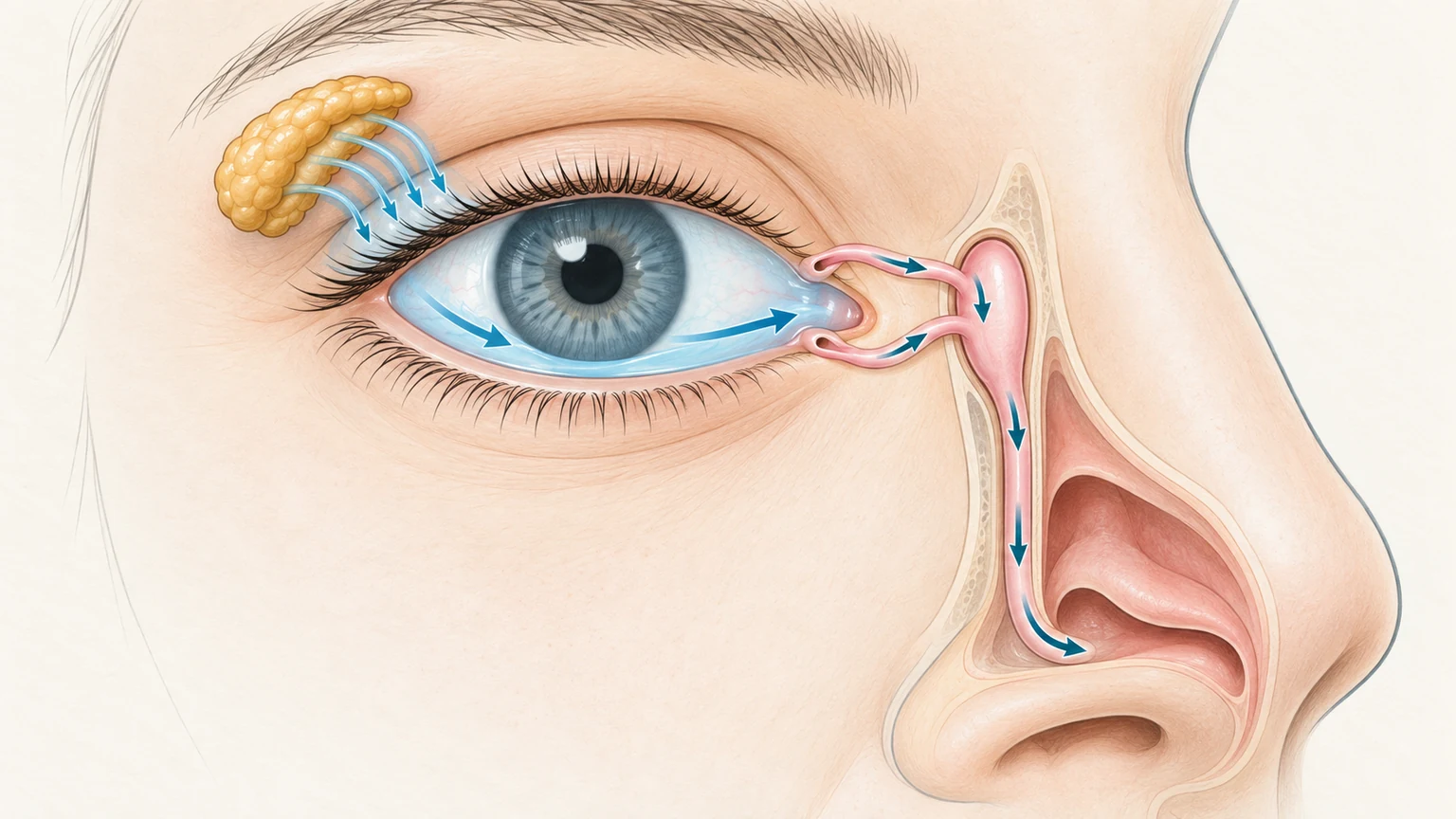
- Left: Tear gland
- Right: Drainage openings, sac, and duct
Tears move from the tear gland across the eye surface and enter two small openings near the inner corner. They pass through small channels into the tear sac, then flow through the tear duct (nasolacrimal duct) into the nose. This is why your nose can run when you cry. Simplified anatomy, not to scale.
Source: National Eye Institute: how tears work. Cambridge University Hospitals: how tears drain.
Watery eyes at the computer
Long screen sessions can set the stage for dryness. You tend to blink less while you concentrate, and air from a fan or vent can speed up evaporation. If your eyes water during screen work while also feeling gritty or tired, the tear film may be part of the story. See what changes during focused screen work.
Our tear film animation shows what happens between blinks: the film thins, dry spots can form, and a complete blink spreads fresh tears across the surface again. Watch the tear film thin between blinks.
Talking to an eye care professional
Because watering has so many possible causes, an eye care professional is the best person to ask about it.
An eye exam can show whether dryness, an allergy, a drainage problem, or something else is behind the watering. For dry eye, eye doctors can examine the tear film directly and measure how many tears your eyes make. See how eye doctors test for dry eye.
Make screen time more comfortable
For more comfortable computer use, check the airflow around your desk and choose a text size you can read without leaning closer. Our guide to dry-feeling eyes at the computer walks through these adjustments. Read about dry-feeling eyes during computer work.
BlinkEasy takes care of the blinking side. It tracks your blink rate through your webcam and reminds you to blink and take a break when you're deep in your work. Try BlinkEasy free for 14 days.